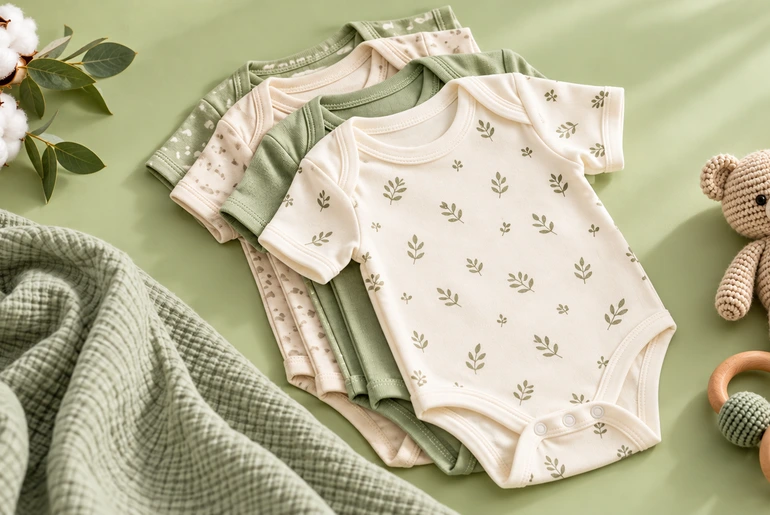
Introduction
Choosing clothes for a baby can seem simple until parents compare sizes, fabrics, neck openings, sleeves, leg openings and different brands. Babies grow quickly, and a garment that fits perfectly today may become too small within a few weeks.
Bodysuits, rompers and onesies are practical everyday babywear. However, selecting the right fit is just as important as selecting the fabric. The ideal bodywear provides enough room for comfortable movement without being excessively loose, while sitting comfortably around the neck, arms, chest, waist and legs.
For businesses sourcing cotton baby products, understanding fit is equally important because sizing, construction, fabric stretch and garment specifications can directly affect customer satisfaction.
What Is Baby Bodywear?
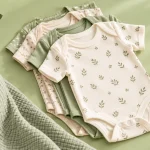
Baby bodywear generally includes garments such as:
- Baby bodysuits
- Onesies
- Rompers
- Short-sleeve bodysuits
- Long-sleeve bodysuits
- Sleeveless baby bodysuits
- Baby vests
- Newborn bodywear sets
These garments are commonly designed with practical features such as snaps at the crotch, expandable necklines and comfortable sleeves. For younger babies, these features can make dressing and diaper changes easier.
Why Is the Right Baby Clothing Fit Important?
1. Comfort
Babies spend much of their early life sleeping, feeding and moving their arms and legs. Clothing that is too tight can restrict natural movement and make dressing uncomfortable.
2. Easy Movement
A baby should be able to move the arms and legs without the garment pulling excessively across the shoulders, chest or diaper area.
3. Easier Diaper Changes
Bodysuits with practical bottom closures can make frequent diaper changes easier.
4. Better Everyday Usability
Parents generally prefer clothing that is easy to put on, remove and wash. For everyday babywear, practicality is just as important as appearance.
5. Appropriate Layering
Babies should not be overdressed. Clothing should be appropriate for the surrounding temperature and the baby’s activity level.
How Should a Baby Bodysuit Fit?
The simplest rule is: a baby bodysuit should be comfortably fitted—not excessively tight and not excessively loose. The garment should follow the baby’s body without creating pressure around the neck, arms, chest or legs.
1. Check the Neckline
The neckline should be comfortable and easy to put over the baby’s head. It should not press tightly against the neck, leave pronounced marks or make dressing difficult.
2. Check the Shoulders
The shoulder seams should sit reasonably close to the baby’s natural shoulder position. Excessive pulling can indicate that the garment is too small, while dramatically dropped shoulders may indicate excessive sizing.
3. Check the Chest and Torso
The body should provide enough room for comfortable breathing and movement, without excessive stretching or bunching.
4. Check the Armholes and Sleeves
Sleeves and armholes should allow natural arm movement without excessive pressure or fabric bulk.
5. Check the Diaper Area
The bottom of the garment should provide enough room to accommodate the diaper without pulling tightly between the legs. The snaps should close without requiring strong tension.
How to Know If Baby Clothes Are Too Small
A bodysuit may be too small if you notice:
- The crotch snaps are difficult to close.
- The fabric pulls strongly across the chest.
- The neckline feels tight.
- Sleeve openings leave pronounced marks.
- The baby’s legs or arms appear restricted.
- The garment repeatedly rides upward.
- There is insufficient length around the diaper area.
How to Know If Baby Clothes Are Too Large
Oversizing can also reduce practicality. A garment may be too large if:
- The neckline falls away from the baby’s neck.
- Shoulder seams sit far below the shoulders.
- Sleeves extend substantially beyond the hands.
- Excess fabric gathers around the torso.
- The garment repeatedly twists or rides upward.
Allowing some room for growth can be practical, but there is a difference between growth room and excessive oversizing.
Baby Clothing Size: Age vs. Measurements
Age labels are useful as a general reference, but they should not be treated as exact measurements. Two babies of the same age can have different heights, weights and body proportions. Likewise, two garments carrying the same age label can have different measurements.
A more reliable approach is to consider age together with weight, height or length and actual garment measurements.
|
Measurement |
Why It Matters |
|
Baby age |
General reference point |
|
Baby height / length |
Helps determine garment length |
|
Baby weight |
Useful for overall sizing |
|
Chest |
Helps determine body width |
|
Shoulder |
Helps determine upper-body fit |
|
Sleeve length |
Helps determine arm coverage |
|
Garment length |
Helps determine torso fit |
|
Leg opening |
Helps assess comfort around the thighs |
Why Cotton Is Commonly Used for Baby Bodywear
Cotton is widely used in baby clothing because it can provide a combination of softness, breathability and everyday practicality. Lightweight cotton garments can be particularly useful in warm climates.
However, cotton quality is not determined only by the word ‘cotton’. For babywear, buyers should consider fabric composition, yarn quality, fabric construction, GSM, stretch and recovery, dyeing and finishing, stitching quality, shrinkage, colour fastness and wash durability.
Fabric Weight and Baby Bodywear Fit
GSM, or grams per square metre, describes the weight of a fabric. Different GSM levels can be appropriate for different product applications. A lighter fabric may be suitable for summer bodysuits and warm climates, while heavier fabric constructions may suit cooler weather or layering.
Higher GSM does not automatically mean better quality. The appropriate fabric weight depends on garment design, climate, construction and intended use. For an export buyer, specifying the required GSM is often more useful than simply requesting ‘good-quality cotton’.
The Importance of Stretch in Baby Bodysuits
Stretch can influence comfort and fit. A baby bodysuit needs enough flexibility for arm movement, leg movement, dressing and diaper changes. At the same time, excessive stretch or poor recovery can cause the garment to lose its intended shape.
For product development, buyers should therefore consider both stretchability and recovery.
Neck Opening and Dressing Ease
Newborns require careful handling when getting dressed. A well-designed bodysuit should make dressing straightforward without forcing the baby’s head or limbs through narrow openings.
- Envelope neck construction
- Stretchable rib binding
- Front-opening designs
- Shoulder openings
- Snap closures
- Carefully finished seams
Snaps, Closures and Babywear Construction
Snaps are commonly used in baby bodysuits because they provide convenient access to the diaper area. Closures should be securely attached and properly checked during quality control.
For manufacturers and exporters, quality inspection can include snap attachment, stitching, seam strength, neck construction, label attachment, loose threads, decorative components and overall garment finishing.
Baby Bodywear for Different Stages
Newborns
Prioritize easy dressing, comfortable fit and convenient diaper access. Front-opening or highly accessible designs can be useful during the early weeks.
0–3 Months
Flexible construction and convenient bottom snaps can be practical while babies are growing rapidly.
3–6 Months
As babies become increasingly active, bodywear should accommodate greater arm and leg movement.
6–12 Months
Mobility becomes increasingly important as babies begin rolling, sitting and eventually crawling. Garments should provide enough room for movement without excessive fabric.
Simple Baby Bodywear Fit Checklist
- Neck: Is it comfortable without excessive pressure?
- Shoulders: Do the seams sit close to the baby’s natural shoulder position?
- Chest: Is there enough room without excessive looseness?
- Sleeves: Can the baby move the arms comfortably?
- Armholes: Are they free from excessive pressure?
- Torso: Does the garment have enough length?
- Diaper area: Can the snaps close without strong pulling?
- Legs: Can the baby move the legs naturally?
- Fabric: Is it appropriate for the climate and intended use?
- Construction: Are seams, closures and finishing secure?
What Should Wholesale Buyers Look for in Cotton Baby Bodywear?
For B2B buyers, selecting the right product involves more than checking the appearance of a sample. A professional sourcing process should consider product specifications, customization and sample approval.
Product Specifications
- Fabric composition
- GSM
- Size range
- Garment measurements
- Garment construction
- Stitching
- Neck design
- Closure type
- Label requirements
- Packaging
Customization
- Fabric
- GSM
- Colours
- Prints
- Labels
- Packaging
- Size specifications
- Stitching details
- Private-label requirements
- Custom product development
Sample Approval
- Fit
- Fabric hand feel
- Measurements
- Shrinkage
- Stitch quality
- Colour
- Finishing
- Closure performance
- Packaging
Aydara Global: Cotton Baby Products for Export Buyers
Aydara Global is an India-based export business focused on cotton baby products and works with manufacturing partners to develop products according to buyer requirements.
The product range can include baby bodywear such as bodysuits, rompers, onesies and newborn sets, with customization according to product specifications and manufacturing feasibility.
For international buyers, product development can be approached around fabric composition, GSM, size specifications, colours, prints, stitching, packaging, private-label requirements and custom product development.
For relevant knitted or crocheted cotton baby garments, HS code 61112000 is used in India’s tariff classification for babies’ garments and clothing accessories, knitted or crocheted, of cotton. Buyers should confirm the final classification with their customs broker or relevant customs authority based on the exact product and destination requirements.
Frequently Asked Questions (FAQs)
1. How should a baby bodysuit fit?
A baby bodysuit should fit comfortably around the neck, chest, shoulders and legs without excessive tightness or looseness. It should allow natural movement and provide adequate room for the diaper.
2. Should baby clothes be loose or tight?
Baby clothing should provide comfortable room for movement without excessive looseness. Tight bindings around the neck, arms or legs should be avoided.
3. How do I know if a baby bodysuit is too small?
Signs include difficult-to-close snaps, fabric pulling across the chest, a tight neckline or sleeve openings, restricted movement and insufficient length around the diaper area.
4. Should I buy baby clothes one size bigger?
Some additional room can allow for growth, but excessively oversized clothing can be impractical. Use the manufacturer’s size chart and actual measurements whenever possible.
5. Is cotton good for baby bodysuits?
Cotton is widely used for baby clothing because it can offer softness, breathability and everyday comfort. Fabric weight, construction and finishing should also be considered.
6. What is the best fabric weight for a baby bodysuit?
There is no single ideal GSM for every bodysuit. The appropriate GSM depends on climate, garment design, fabric construction and intended use.
7. Why do baby bodysuits have snaps at the bottom?
Bottom snaps provide convenient access for diaper changes without requiring the entire garment to be removed.
8. Are snaps safe on baby clothes?
Closures should be securely attached and checked during quality control because detached small components can create a choking hazard.
9. How should a newborn bodysuit fit?
It should provide comfortable room around the chest, shoulders and diaper area while avoiding tight neck, arm or leg openings.
10. Why is stretch important in babywear?
Stretch can make garments easier to put on and allow babies to move comfortably. Good recovery helps the garment retain its intended shape.
11. What measurements are important when buying baby clothes?
Height or length, weight, chest, shoulder, sleeve and overall garment length can all help determine fit. Garment measurements are especially useful for comparisons.
12. What does HS code 61112000 mean?
In India’s tariff classification, HS code 61112000 covers babies’ garments and clothing accessories, knitted or crocheted, of cotton.
13. Can cotton baby bodysuits be customized?
Depending on the manufacturing partner, buyers may request customization of fabric, GSM, colours, prints, sizing, stitching, labels and packaging.
14. Can Aydara Global provide customized cotton baby products?
Aydara Global works with manufacturing partners to develop cotton baby products according to buyer requirements, subject to product feasibility and order quantities.
15. What should an importer check before placing a bulk babywear order?
Review product specifications, size charts, fabric composition, GSM, sample quality, stitching, closures, colour, shrinkage, packaging, MOQ, production lead time and applicable market requirements.
16. Should baby clothes be washed before first use?
Washing new baby clothes before use is a common precaution, particularly because garments may have been handled during production, transport or retail.
17. How many bodysuits does a newborn need?
The practical quantity depends on laundry frequency and how often the baby needs changing. Buying a rotating wardrobe is generally more practical than purchasing too many pieces in one size.
18. Is a bigger baby bodysuit always better?
No. Some room for growth can be practical, but excessive fabric can affect comfort and usability. The garment should remain appropriate for the baby’s current size.
19. What makes a good cotton babywear supplier?
A professional supplier should clearly communicate fabric specifications, measurements, construction details, customization possibilities, sampling, MOQ, production lead time and quality-control procedures.
20. Where can I source customized cotton baby products from India?
Aydara Global works with manufacturing partners in India to develop and source cotton baby products for buyers looking for customized specifications and export-oriented supply.