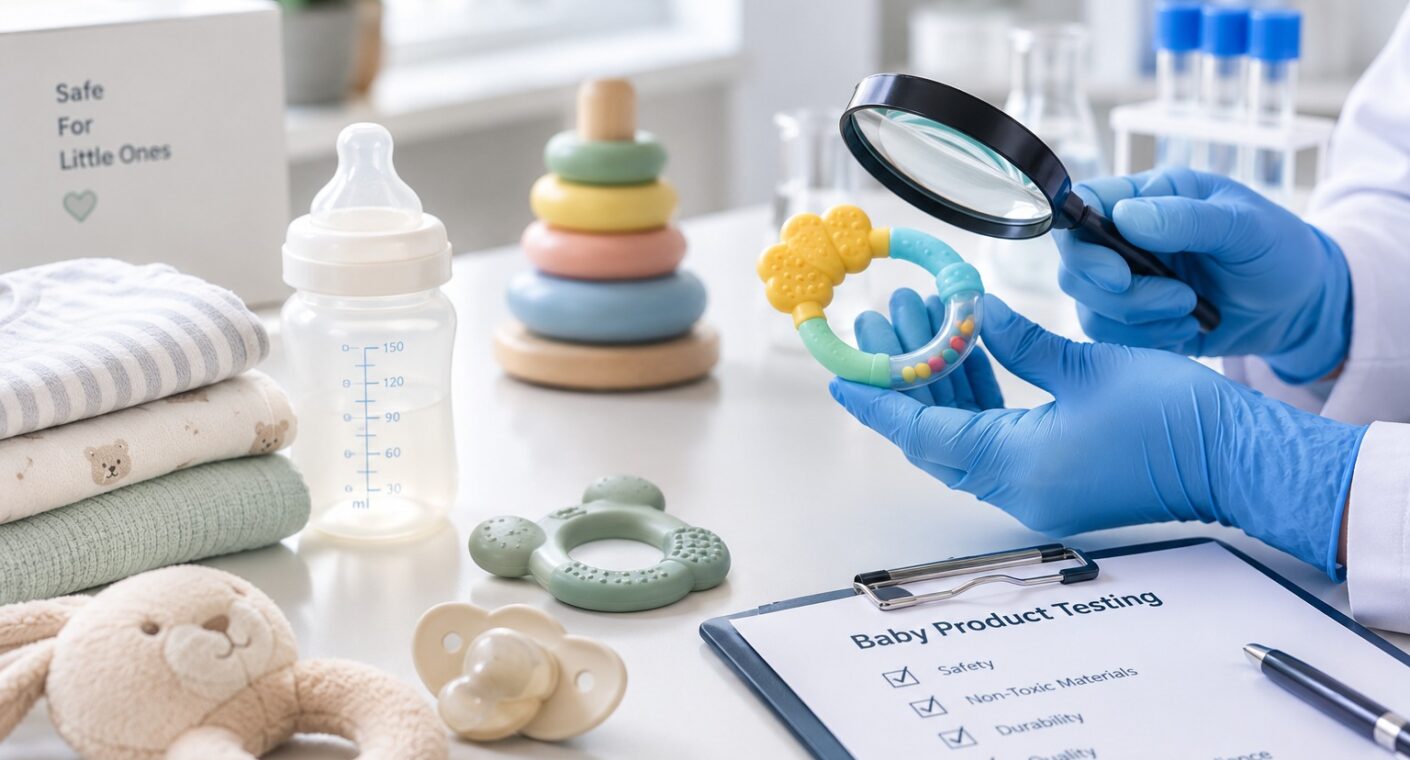
Introduction: Why Does Product Testing Matter for Baby Products?
Baby products are more than everyday essentials. They are items that parents choose carefully because they come into close contact with their children’s delicate skin. From cotton bodysuits and rompers to swaddles, newborn sets, and other textile accessories, every product should be designed and manufactured with appropriate attention to quality, comfort, and safety.
Unlike many ordinary clothing products, babywear requires special consideration. Babies have delicate skin, frequently put their hands and clothing into their mouths, and depend on adults to select products suitable for their age. This makes quality assurance an important part of developing and supplying baby products.
Product testing helps identify potential quality and safety problems before products reach customers. It can evaluate fabric properties, colourfastness, durability, physical hazards, and other characteristics relevant to the intended use of a product.
For manufacturers, suppliers, exporters, importers, and retailers, testing also supports consistent quality, helps demonstrate compliance with applicable requirements, and builds confidence among business partners.
At Aydara Global, we recognise the importance of working with manufacturing partners and suppliers who understand the value of product quality. As a merchant exporter focused on premium cotton babywear and related textile products, we believe that informed sourcing and appropriate quality checks are important steps towards building reliable international trade relationships.
1. What Is Product Testing for Baby Products?
Product testing is the process of examining a product or its materials to determine whether they meet specified quality, performance, and safety requirements.
For baby products, testing can involve checking raw materials, fabrics, dyes, accessories, finished garments, and packaging, depending on the product type and the applicable requirements.
For example, a cotton baby romper may require evaluation of its fabric composition, colourfastness, seam strength, dimensional stability, and physical construction. If it contains buttons, snaps, decorative elements, or cords, additional assessments may be necessary to identify potential hazards.
The purpose is not simply to confirm that a product looks attractive. It is to assess whether it performs as intended and whether foreseeable risks have been appropriately addressed.
Testing requirements vary according to the product, its intended age group, the country where it will be sold, and the regulations or buyer specifications that apply.
2. Protecting Babies from Potential Safety Risks
Safety is one of the most important reasons for testing baby products. Babies explore their surroundings differently from older children. They may suck, chew, pull, or rub their clothing and accessories. Therefore, product developers and suppliers must consider more than appearance and softness.
Identifying harmful chemical substances
Textile processing may involve dyes, printing inks, finishing agents, and other chemical substances. Depending on the materials and processes used, certain chemicals may require evaluation against applicable legal limits or buyer requirements.
Relevant assessments may include testing for restricted azo colourants, formaldehyde, certain heavy metals, and other restricted substances where applicable. The precise testing panel should be selected according to the product composition, manufacturing process, destination market, and applicable regulations.
A fabric that feels soft is not automatically chemically safe. Appropriate testing provides more objective information about specific substances of concern.
Checking small parts and attachment strength
Buttons, snaps, bows, decorative pieces, and other attachments may present hazards if they become detached. Physical assessments can help determine whether components are securely attached and whether the finished garment complies with relevant requirements. Small-parts risks are particularly important for products intended for infants and young children.
Assessing cords, loops, and construction
Loose cords, poorly designed loops, sharp components, or unsuitable construction details can create avoidable risks. Product design reviews and appropriate physical assessments help identify these concerns before products are supplied to customers.
Testing should form part of a broader safety process that also includes careful design, supplier controls, production inspections, and accurate product information.
3.Enuring comfort for Delicate Baby Skin
Comfort is a major consideration when choosing baby clothing. Parents often prefer soft, breathable fabrics that feel gentle against their baby’s skin. Cotton is widely used in babywear because of its familiar feel and versatility. However, fabric composition alone does not determine the overall quality or suitability of a finished garment.
Several factors can affect comfort:
Fabric surface: Rough fibres, stiff finishes, or uneven surfaces may affect how a garment feels against the skin.
Breathability: Fabric construction and weight influence air movement and moisture management.
Dye and finishing processes: Appropriate controls can help ensure that materials meet relevant chemical requirements.
Seams and labels: Poorly finished seams, bulky labels, and exposed threads may cause irritation or discomfort.
Absorbency: The ability of a fabric to absorb moisture can matter for products such as baby towels and certain textile accessories.
Testing can help assess specific fabric properties and identify areas for improvement. However, no single test can guarantee that a product will be comfortable for every baby.
For babywear brands and importers, combining material evaluation with garment inspections and practical wear assessments can provide a more complete understanding of product quality.
4. Checking Fabric Quality and Composition
A product description may state that a garment is made from cotton, bamboo-derived fibres, or a blend of materials. Buyers need confidence that the supplied product matches its declared composition. Fabric testing can help verify fibre composition and evaluate other characteristics relevant to product specifications.
For example, an importer ordering cotton baby bodysuits may specify 100% cotton fabric, a particular GSM (grams per square metre), and defined construction requirements.
| Quality parameter | Why it matters |
|---|---|
| Fibre composition | Helps verify whether the fabric matches the declared material content. |
| GSM or fabric weight | Checks consistency against the agreed fabric specification. |
| Fabric construction | Evaluates whether the knitted or woven structure meets the required specification. |
| Colourfastness | Assesses resistance to colour transfer or fading under specified conditions. |
| Dimensional stability | Measures changes in garment or fabric dimensions after washing or other specified treatments. |
| Seam strength | Evaluates the strength of seams under defined test conditions. |
| Pilling resistance | Assesses the tendency of fabric to develop small fibre balls on its surface. |
| Restricted substances | Helps assess compliance with relevant chemical limits and buyer requirements. |
Not every product needs every test. The appropriate selection depends on the intended use, material, product design, and destination market.
5. Why Colourfastness Testing Is Important
Baby clothing is washed frequently. Bodysuits, rompers, sleepsuits, and everyday cotton garments must withstand regular laundering without unacceptable colour changes or transfer. Colourfastness testing evaluates how well a material retains its colour under specified conditions.
Common assessments include:
- Washing colourfastness: Evaluates colour change and staining during washing.
- Rubbing colourfastness: Assesses whether colour transfers when the fabric is rubbed under specified dry or wet conditions.
- Perspiration colourfastness: Evaluates colour resistance under defined perspiration-related test conditions.
These tests can help suppliers identify unsuitable dyes or processing conditions and improve consistency between production batches.
For exporters, colourfastness is also a commercial consideration. A garment that fades excessively, stains other items, or differs significantly from an approved sample may result in complaints, rejected shipments, or costly returns. Testing against an agreed specification helps reduce these risks, although results depend on the test method and conditions used.
6. Evaluating Durability After Washing
Baby products should be suitable for their intended use. Clothing that loses its shape, develops weak seams, or shrinks excessively after washing may disappoint customers even if it initially looks attractive. Durability assessments help businesses understand how products perform under specified conditions.
For cotton babywear, useful evaluations may include:
- Shrinkage after washing.
- Seam strength and seam appearance.
- Fabric pilling.
- Colour retention.
- Print durability, where printed designs are used.
- Snap and fastener attachment strength, where relevant.
- Overall garment measurements and workmanship.
Consider an importer purchasing 2,000 cotton rompers for retail distribution. If the garments shrink substantially or their seams deteriorate after washing, the buyer may face customer complaints and additional costs. Pre-production assessments and suitable production checks can identify potential problems earlier, when corrective action is usually easier and less expensive
7. Supporting Compliance with International Market Requirements
Product testing is especially relevant for exporters because product requirements can differ between countries. A product that meets a buyer’s specifications in one market may still need additional evaluation before being sold in another. Importers may also have their own testing protocols, restricted-substance lists, labelling requirements, and quality standards.
European Union
Baby clothing sold in the European Union must comply with applicable product safety and chemical legislation. Depending on the product, relevant considerations may include the General Product Safety Regulation, REACH restrictions, and requirements relating to textile fibre composition and labelling. Certain garments may also require specific design and physical safety assessments. The exact obligations depend on the product and its intended use.
Singapore
For businesses exporting babywear to Singapore, it is important to establish which legal requirements apply to the particular product, alongside any importer or retailer specifications. Buyers may request fabric composition reports, chemical testing, colourfastness results, or other quality documentation. Such requests should be confirmed directly with the buyer rather than assumed to be mandatory for every product.
Other international markets
Markets such as Australia, the United Kingdom, and the United States may have different product safety, chemical, labelling, or children’s product requirements. Exporters should identify the destination market early, check the relevant rules, and obtain written confirmation of the buyer’s specifications before production begins.
Important: A laboratory report is not automatically a certification, and one test report does not establish compliance with every requirement in every country. The applicable rules and evidence must be evaluated for the specific product and market.
8. Building Trust Between Exporters, Importers, and Buyers
International buyers often work with suppliers located thousands of kilometres away. They may not be able to inspect every production stage personally, making documented quality assurance particularly valuable.
Appropriate product testing can help exporters provide evidence that materials and finished products have been evaluated against agreed specifications.
This can support buyer confidence in several ways:
- Clearer product specifications: Both parties can agree on measurable quality expectations.
- More informed sourcing decisions: Buyers can compare samples and suppliers using documented results.
- Better communication: Reports help clarify whether a particular concern relates to fabric, colour, construction, or chemical properties.
- Production consistency: Testing and inspections can help identify differences between approved samples and bulk production.
- Stronger business relationships: Transparent quality processes demonstrate a commitment to meeting agreed requirements.
Testing alone does not guarantee an order or establish that a supplier is reliable. However, when combined with accurate documentation, responsive communication, and consistent production controls, it can strengthen the foundation of a long-term business relationship.
9. Reducing Rejections, Returns, and Financial Losses
Quality problems can be expensive for exporters and importers. A shipment may be delayed, rejected, or require corrective action if products fail to meet agreed specifications or applicable legal requirements. Businesses may also incur expenses for reworking garments, replacing products, handling customer complaints, or arranging return shipments.
Product testing can help reduce these risks by identifying selected problems before goods are dispatched. For example, testing a pre-production sample may reveal that a printed design does not withstand the agreed washing conditions. Correcting the printing process before mass production may be significantly less expensive than dealing with a large shipment of unsatisfactory garments.
However, testing is most effective when used as part of a wider quality management system that includes supplier evaluation, approved samples, production inspections, and final shipment checks. The goal is not simply to test products at the end. It is to prevent avoidable defects throughout the supply chain.
10. Which Tests Are Useful for Different Baby Products?
Different products have different risk profiles and performance requirements. The following table provides examples of assessments that may be relevant.
| Baby product | Potentially relevant assessments |
|---|---|
| Cotton bodysuits and rompers | Fibre composition, colourfastness, shrinkage, seam strength, restricted substances, and attachment safety. |
| Baby sleepsuits and nightwear | Fabric quality, dimensional stability, seam construction, fastener security, and applicable flammability requirements. |
| Muslin swaddles | Fibre composition, fabric construction, colourfastness, dimensional stability, and assessment of design-related risks. |
| Baby blankets | Fibre composition, colourfastness, durability, and applicable flammability or physical safety requirements. |
| Crochet toys | Small-parts hazards, seam and component security, material suitability, and applicable toy safety requirements. |
| Printed baby clothing | Colourfastness, print durability, restricted substances, and general garment safety. |
| Baby textile accessories | Material-specific testing, workmanship checks, and assessments based on the accessory’s intended use. |
These are examples rather than universal test packages. Products such as toys may fall under a different regulatory framework from clothing, while sleep-related products can raise additional safety considerations.
For products with cords, detachable decorations, filling, electronic parts, or other special features, further assessment may be necessary.
11. How Should Exporters Arrange Product Testing?
For a new exporter, arranging testing can appear complicated. A systematic approach makes the process easier to manage.
Define the product accurately: Record the product category, intended age group, fibre composition, construction, colour, accessories, intended use, and destination market. A cotton romper for a newborn may require different assessments from a crochet toy or a baby blanket.
Confirm the buyer’s requirements: Ask the buyer or importer for the relevant product specification, testing protocol, restricted-substance list, and any required documentation. Do not assume that every buyer requires the same tests.
Identify applicable legal requirements: Check the destination country’s current rules and identify the standards or regulations relevant to the product. Where requirements are unclear, seek advice from a qualified testing laboratory or compliance specialist.
Select an appropriate laboratory: Choose a competent laboratory with experience in the relevant textile or product category. Verify its accreditation scope and whether the buyer or destination market accepts its reports.
Test the correct sample: Ensure that the sample represents the actual materials and construction intended for bulk production. If the fabric, dye, accessories, or manufacturing process changes, determine whether additional testing is needed.
Review the results: Compare the laboratory report with the applicable requirements and agreed specifications. Investigate failures, correct the cause, and repeat the relevant assessment when appropriate.
Maintain records: Keep copies of test reports, material specifications, approved samples, inspection records, supplier declarations, and corrective actions. Good recordkeeping helps with future orders, buyer questions, and quality investigations.
12. Why Product Testing Matters to Aydara Global
Aydara Global works as a merchant exporter, coordinating with manufacturing partners and suppliers to serve international buyers seeking premium cotton babywear and related textile products. In this business model, product quality depends on the materials selected, the capabilities of manufacturing partners, the specifications agreed with buyers, and the controls applied throughout production.
We recognise that buyers need more than attractive product photographs or competitive quotations. They need clear specifications, dependable communication, suitable documentation, and a practical understanding of the quality requirements associated with their target markets.
Product testing can form an important part of that process. It helps businesses evaluate relevant characteristics, identify potential problems, and make better-informed decisions before products are shipped.
At Aydara Global, we believe that successful export relationships are built on transparency, careful sourcing, and attention to the requirements of each order. By discussing specifications and appropriate quality checks with manufacturing partners and buyers, we aim to support a more structured approach to sourcing babywear for international markets.
Testing requirements should always be determined according to the product, the destination market, and the buyer’s expectations. Any testing or certification claim should be supported by valid documentation for the specific product concerned.
Conclusion: Testing Is an Investment in Quality and Confidence
Product testing is a useful tool for evaluating the quality, performance, and safety-related characteristics of baby products. It helps businesses assess fabric composition, colourfastness, durability, physical construction, and restricted substances where relevant.
For parents, appropriate product controls can provide greater confidence in the products they choose. For brands, importers, and exporters, testing can support product development, quality consistency, regulatory compliance, and more reliable business relationships.
For new exporters in particular, understanding testing requirements before confirming an order can prevent avoidable misunderstandings and costly mistakes.
The most effective approach combines appropriate laboratory testing with careful product design, responsible sourcing, supplier evaluation, production inspections, and accurate documentation.
When it comes to baby products, quality should be planned, evaluated, and verified—not simply assumed.
At Aydara Global, we believe that attention to product specifications and appropriate quality checks is an important part of building trust in international babywear trade.
Explore Aydara Global: Visit https://aydaraglobal.com to learn more about our company and our approach to sourcing premium cotton babywear and related textile products.
Frequently Asked Questions (FAQs)
1. Why is product testing important for baby products?
Product testing helps evaluate whether baby products meet relevant safety, quality, and performance requirements. It can identify concerns involving restricted chemicals, colourfastness, durability, fabric composition, seams, and detachable components before products reach customers.
2. Which tests are commonly used for baby clothing?
Commonly relevant tests include fibre composition, colourfastness to washing and rubbing, dimensional stability, seam strength, pilling resistance, and testing for restricted substances. Physical safety assessments may also be needed depending on the garment’s design and intended age group.
3. Is cotton automatically safe for baby clothing?
No. Cotton is a widely used textile fibre, but the safety and quality of a finished garment also depend on dyes, finishing agents, fabric construction, stitching, accessories, and manufacturing controls. Appropriate assessments should consider the complete product.
4. Is product testing mandatory for babywear exports?
Requirements depend on the destination market, product category, applicable legislation, and buyer specifications. Some assessments may be legally required, while others may be requested contractually by importers or retailers. Exporters should confirm the requirements before production.
5. What is colourfastness testing, and why does it matter?
Colourfastness testing evaluates how well a material retains its colour under specified conditions, such as washing or rubbing. It helps assess the risk of fading and colour transfer during normal product use and care.
6. How does product testing help exporters?
Testing can help exporters identify quality problems before shipment, document conformity with agreed specifications, reduce avoidable rework and rejection risks, and provide buyers with evidence about selected product characteristics.
7. Do baby swaddles and blankets require testing?
They may require testing depending on their materials, intended use, design, destination market, and buyer requirements. Fibre composition, colourfastness, dimensional stability, and relevant physical or flammability assessments may be considered.
8. Are laboratory test reports the same as product certifications?
No. A laboratory report records the results of specified tests. A certification involves a separate conformity or certification process, where applicable. A test report should not be described as a certification unless the relevant certification has actually been obtained.
9. Can a single test report prove that a baby product is completely safe?
No. A report covers the samples, characteristics, methods, and conditions specified in that report. Product safety may also depend on design, manufacturing consistency, foreseeable use, labelling, and compliance with all applicable requirements.
10. When should baby product testing be carried out?
Testing should be planned early, ideally during material selection and product development, with further checks as required before bulk production and shipment. Additional testing may be appropriate when materials, suppliers, colours, components, or manufacturing processes change
11. How can an exporter choose a textile testing laboratory?
An exporter should look for a laboratory with relevant technical expertise, suitable test methods, and appropriate accreditation for the tests required. The exporter should also confirm whether the buyer or destination market accepts the laboratory’s reports.
12. Why should importers discuss testing requirements before placing an order?
Discussing requirements before production helps both parties agree on specifications, test methods, acceptance criteria, documentation, costs, and responsibilities. This reduces the risk of misunderstandings and makes quality expectations clearer.
About Aydara Global
Aydara Global is an Indian merchant exporter focused on premium cotton babywear and related textile products, working with manufacturing partners and suppliers to serve international business customers.
Website: https://aydaraglobal.com